
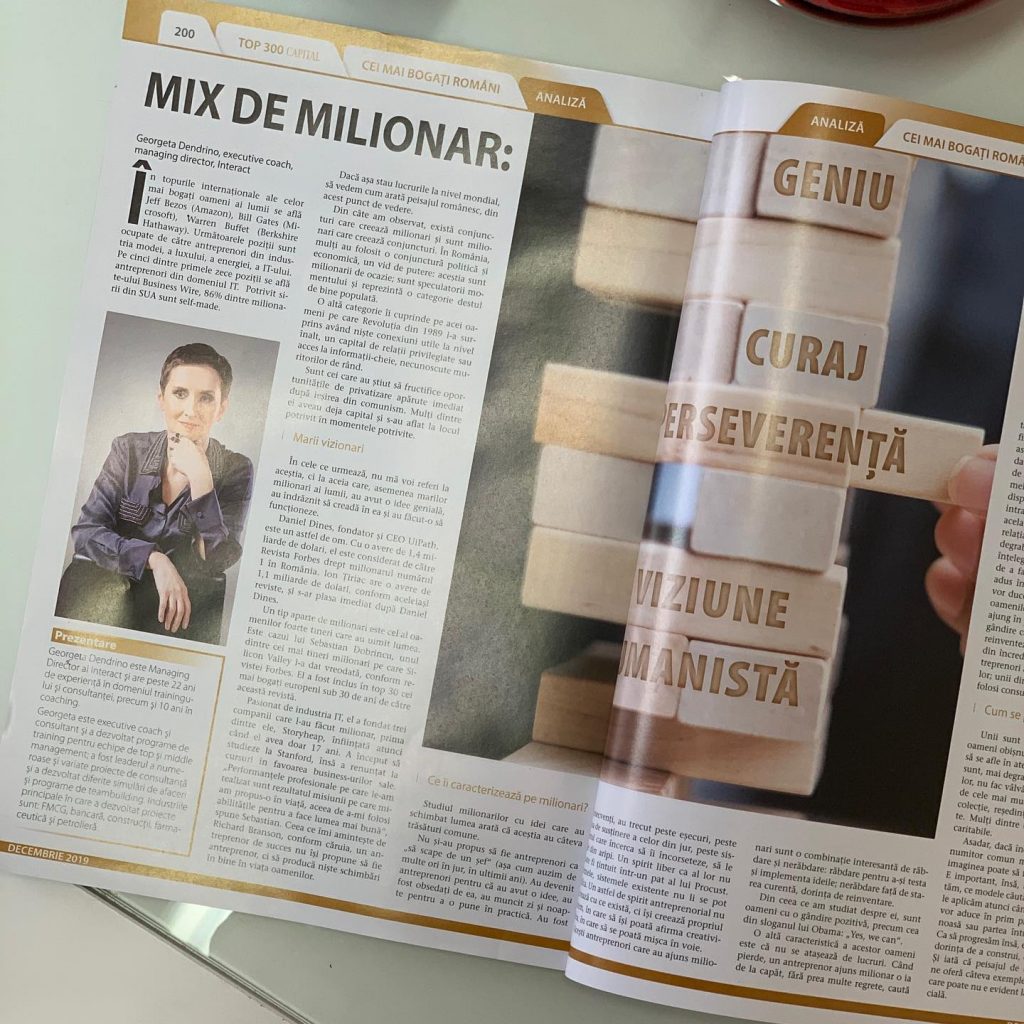
Author: Gerorgeta Dendrino, Executive Coach, Managing Director Interact
In the international tops of the richest people on earth you will find Jeff Bezos (Amazon), Bill Gates (Microsoft), Warren Buffet, (Berkshire Hathaway). The next positions are taken by entrepreneurs from the fashion and luxury industry, the energy industry, the IT industry. The first five positions in top 10 are occupied by entrepreneurs from the IT field. According to Business Wire, 86% of millionaires from the USA are self-made.
If this is how things present themselves worldwide, let’s take a look at the Romanian business landscape from this point of view. From what I have noticed, there are circumstances that create millionaires and some millionaires that create circumstances.
In Romania, many have used the political and economic circumstances, a power void: those are opportunistic millionaires; momentary speculators and they represent a well-established category.
Another category comprises of people that the 1989 Revolution caught with useful connections, a capital of privileged relationships or access to key-information, unknown by mere mortals. They are the ones who managed to take advantage of privatization opportunities that emerged immediately after the communist regime fell. Many of them already had the capital and they were just in the right place at the right time.
Major Visionaries
In what will follow, I will not refer to them, but to the ones who, like the major millionaires of the world, had a brilliant idea, dared to believe in it and made it work.
Daniel Dines, founder and CEO of UiPath is that kind of person. With a fortune of $1.4 billion, he is considered by the Forbes Magazine to be the number one millionaire in Romania. Ion Tiriac has a fortune of $1.1 billion, according to the same magazine, right behind Daniel Dines.
A special type of millionaire is that of very young people who astonished the world. This is the case of Sebastian Dobrincu, one of the youngest millionaires Silicon Valley ever created, according to Forbes. He was included in the 30 under 30 richest Europeans by this magazine.
Passionate about the IT industry, he founded three companies that made him a millionaire, one of which, Storyheap, he started when he was only 17 years old. He started studying at Stanford but quit in favor of his businesses. “ My professional performance is the result of the mission that I set for my life, that of using my abilities for creating a better world.”, says Sebastian. Which reminds me of Richard Branson, according to which, a successful entrepreneur does not set out to become an entrepreneur, but to create a positive change in people’s live.
What characterizes millionaires?
The study of millionaires with ideas that changed the world shows that they have some common traits. They did not set off to become entrepreneurs to “ get rid of their boss” (as I have heard many times around me in recent years). They became entrepreneurs because they had an idea, they obsessed over it, they worked night and day to put it in practice. They were consistent, got over failures and the lack of support from those around them, and found a workaround the system that tried to restrain them, to cut off their wings. A free spirit like theirs cannot be kept in a Procrustean bed. The existing forms and systems do not apply to them. Such an entrepreneurial spirit does not work with what already exists, but with their own system, where they can express their creativity and move freely.
These entrepreneurs who became millionaires are an interesting combination of patience and impatience: patience to test and implement their ideas; impatience towards the status quo, the wish to reinvent.
From what I have studied about them, they are people with positive thinking, like the one from Obama’s slogan: “Yes, we can.”
Another characteristic is that they do not grow overly attached to things. When they lose, an entrepreneur who becomes a millionaire starts over, without too much regret; they search for profitable solutions, with a mobile mentality, a high degree of flexibility and a lot of self-belief.
Many millionaires made it because, apart from their abilities mentioned above, apart from the circumstances, they managed to take advantage of the enthusiasm and creativity of people around them. It is an important quality of a leader that knows how to capitalize on what others are doing.
Local particularities
In Romania, one important aspect is the way millionaires build their companies, their corporate governance so that the business would exist even after the founder left. We all have examples of this kind of millionaires who build their companies and wealth to a great extent, but when they were gone, for whatever reason, everything fell apart. The reason could be that they do not seek the help of consultants or that their relationship with them is rather cold, not based on trust. What they do not sometimes understand is that the mentality, the way of doing things, the circumstances that brought them their wealth will not lead them forward. Just like people, companies have life cycles: they come to a point where a different type of thinking is required to support them, to help them reinvent themselves. This behavior comes from the fact that many entrepreneurs turned millionaires rely too much on their intuition; some of them do not recognize the need to use business consultants.
How does a millionaire behave?
Some are very eccentric, others are regular people, somewhat withdrawn, staying away from the press. I noticed that they tend to focus on their business. However, they have common passions, most of the time: yachts, collectable cars, exotic properties, private jets. Many of them donate to charitable causes.
So, if we were to bring all Romanian millionaires on the same page, the image could be quite fragmented. However, it is important to look at what models we are searching for. The filters that we apply when we look at something will bring to our attention the bright side or the dark side of things. To make a progress, it is good to look with the desire to build, to find inspiration. And so, the Romanian business landscape offers us a few examples to admire, something that may not be apparent at first glance.