
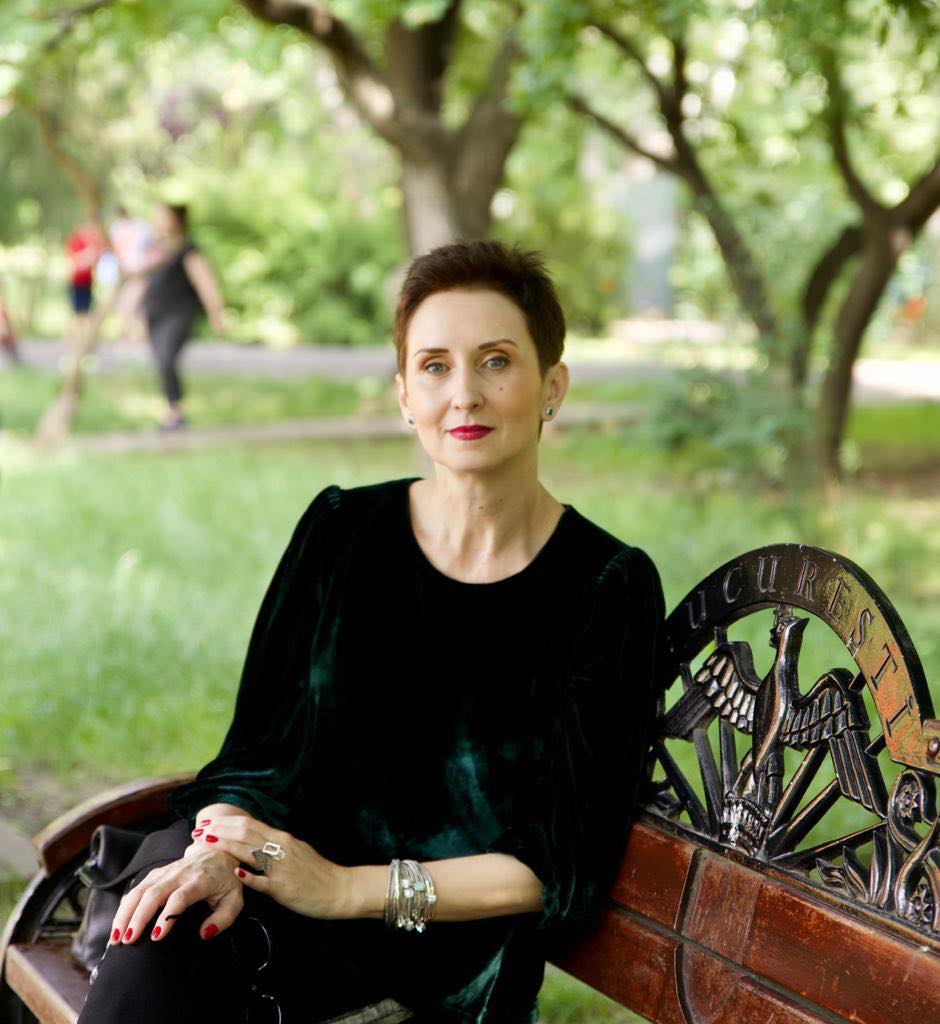
”With experience in entrepreneurship, leadership and team development and strategic management, Georgeta Dendrino is the Managing Director of Interact, with 22 years of activity in training and consulting. She has an Executive Master in coaching and consulting at INSEAD Business School (France) and is, since 2019, Global Mentoring Vice President of the Professional Women’s Network – the largest business network for women and with 28 branches worldwide – and a member in the board of the Association for Values in Education.
Beyond the impressive experience and qualifications gained in many years of work and effort, Georgeta Dendrino is the one who urges us to remember what we are passionate about: “What we enjoy will support us when it is difficult”, in a current context that is difficult for most people.
She understands people, teams and has developed numerous training programs for top and middle management teams, as well as consulting projects and teambuilding programs. She is the professional who values ”more sincere, more authentic conversations”, the involvement in causes that matter to us, the importance of self-knowledge and the desire to always try to be better. In her opinion, “changes do not happen overnight, they require consistency, patience”, and the training she develops and coordinates is under the sign of quality work, of the road traveled without skipping essential stages. In an interview given exclusively to PortalResurseUmane.ro, Georgeta Dendrino reminded us of the values that hold together the teams and internal structures of a company, emphasizing what helps us build long-term and authentically.
1. If you were to make a portrait of the company landscape in Romania in the last three months, where do you consider that not enough work has been done in relation to employees and what should we intend to change, in terms of human resources, in the future?
I think that many firms have made great efforts to rethink the way employees work, the way managers collaborate with their teams, they have supported them; I know some people offered to take their office chairs home if the employees wanted to. I noticed the care for employees.
At the same time, I also saw the opposite:
There is a large area of distrust in people on the part of managers; too many meetings, still; control: how much time they are online, how many breaks did they take, instead of looking at results.
Investments in employee development- stopped in many places, just when they needed to be asked how they felt, how they can be supported.
Communication and creating a safe psychologically environment, creating together an optimal level of responsibility.
More sincere, more authentic, meaningful conversations – at least for a while I think that many people would want to have less to do with political games in organizations and be a part of meaningful, sincere, compassionate conversations. A lot of work is still needed here, for each individual involved.
2. We are still going through a period of crisis that we do not know how to completely define. We also do not know what effects this change will have in the long run. How should we better protect ourselves emotionally, regardless of the positions we have?
This is quite complex. It seems to me that it is difficult to protect yourself alone, if you have not also worked with yourself before, if you do not have a personal discipline.
And yet, I would say that it is good:
- To have a schedule to follow.
- To connect with the people who matter to us: family, friends, colleagues. I know it is difficult, I know that we do not have time, but we can make time. We need to be with others, to “place” ourselves besides the world, to see other perspectives. Especially if we live alone. Excessive isolation opens a dangerous door: that of depression
- To remember our passions; what we enjoy doing will support us when things get difficult
- To go outside, even if we do it alone, for a walk on the street , with no apparent meaning. Going on foot helps us keep our minds in control, giving it various images, ideas; it helps us maintain a healthier state of our body. We sit a long at home, when no one sees us, we tend to slouch, and then our back hurts. I have a friend who during the state of emergency, did 5000 steps per day in his house
- To be involved in a cause. I am involved in AVE( The Association for Values in Education) and PWN (Professional Women’s Network). At AVE we work with school headmasters to support the education in Romania, we have a very ambitious vision to which many people from the business field have joined. At PWN we support the development of a society that takes into account gender balance. I saw others who brought food to elderly people in the first months of the pandemic. There are so many opportunities to get involved! Only if we wanted to! Being involved will give us a feeling of contribution, of utility, of meaning. Without meaning I do not know what we are!
3. I believe a lot in what we can learn from others, through the exercise of admiration. What do you consider that are the most important lessons learned over the 22 years of experience in consulting and training, one that anyone who wishes more from the present moment could learn from?
The exercise of admiration- it is beautifully said! And yet, there are so few contemporary figures left that we can admire, especially in our Romanian society. Admiration entails, for me, excellence, continuous search, openness, passion, generosity.
I was thinking about the people who I admired over the years. It was Steve Jobs, for his vision, passion and ‘madness’, the boldness in trying to change the way we communicate. But I also had teachers who I admired. My Romanian and French teachers inspired me through their presence, their ease (in a time when it was difficult to freely express yourself), their passion for their job and the Parisian air, of freedom, of dreaming and confidence they gave me.
The people who I admired left a mark on who I am right now. I also have a teacher, from Insead, who I admire for what he has created in the field of leadership, executive coaching, change management, for the energy with which he writes, gives courses, he is involved in many projects, even if he is old.
Beyond all the people who I admire, however, I believe that it is essential to know ourselves, to accept what we cannot change and to always search for the way to becoming better people. In itself, it is difficult step, it takes us many years to say that we are on the right track, but without this step it is difficult to find in ourselves the generosity to truly admire others. This is one of the most important lessons for me.
4. We build together with others. What are the risks when we want to build something alone, when we isolate ourselves on our way to the top, whether we are entrepreneurs or CEOs?
There are people who prefer to work alone, who are more withdrawn. For them it can be more difficult to be surrounded by many people, it can be tiring; they are more clumsy in approach, and have a kind of indulgent shyness. That is how they can do things, which I wouldn’t say it’s bad.
They can be supported to take actions in an educated way to gather people around them.
This questions reminds me of a situation: 15 years ago we had a teambuilding with my company, Interact, in Transylvania, at a farm with horses. I remember that at some point in which I was further ahead of everyone, on foot, alone; I shouted: come hurry up, the night will catch up! And they answer me back, in a chorus: ‘then wait, that is a teambuilding!’. I waited and learned my lesson.
When you go like that, alone, you run the risk of being alone, of being afraid that the night is coming, that is getting colder, without anyone to talk with. It is the same in business: you can take so much distance that no one will be around, even if physically they are not far away. You get lost from others.
A long time ago, when I did the mountain guide course, I climbed Piatra Craiului, during an awful blizzard. There we tough times, we walked on chains, we were afraid. There was a guide in the front and one in the back. The rhythm of the team was given by those who walked slower.
A CEO, an entrepreneur, has the duty of looking into the future, to show the way, but also to ensure that everyone in the team is with him/her.
5. The spring of this year forced us to introspect, whether we wanted to or not. Many people lost their jobs, their businesses, or were sent to technological unemployment. How does coaching help us redefine our trajectory, but also the present?
Coaching can help us, as long as we want help. Then, it is important to carefully select our coach. For several years, coaches have appeared as mushrooms appear after the rain, there is this danger of dilettantism.
I admit that I am more old-fashioned when it comes to this: I believe in the doctor who really studied medicine, in the psychologist who studied, took exams, without having to buy a diploma, in an engineer who built a bridge after he/she learned for a long time how things are done.
Another important aspect is to be willing to build a certain personal discipline that we follow. Changes will not happen overnight, they require consistency, patience. A coach can guide you, help you to find the best way for yourself, he/she can be there for you when you need it, but you have to go that way.
6. Competition often makes us unable to see the opportunities that are collaboration would bring. How do we build a successful partnership? Does training and consulting provide us with the necessary means to have a greater openness to new business relationships where cooperation is required?
I think that it is very important to find people who we can trust in building something together. Many so-called partnerships fail because one of the parties is, as an octopus, with tentacles in several boats, interested in all boats and none at the same time.
It is not simple to trust others, we are in a society that have shaken a lot the meaning of the word ‘trust’.
Training can help us to better understand people, adjust our expectations, to better clarify things from the start, in a collaboration, to withstand the need to dominate, to exercise our power, our big egos.
In the end, however, we will not know how a collaboration would go unless we try; it is possible to fail, but it is good to learn how to come back, not to fall into amnesia, and to resume on better grounds.
7. Because we owe it to ourselves to strive for lifelong learning, what books you would recommend that you think have the greatest impact in helping us to grow?
It is hard to recommend a few books because it depends on the moment someone finds him/herself in life. However, I would recommend reading literature, the great authors of all ages, you will find there all the world’s metaphors sung differently. Those books put our mind to work better than any other book. It is good for our minds to be like the great libraries of the world, furnished with Cervantes, Dante, Bukowski, Flaubert, Byron, Dostoyevsky, Mircea Eliade, Isabel Allende (just to name a few authors from various countries). Then we can add business books, those for personal development. Personal development books without a good basis seem to me like polishing without chocolate, without content. They can give us the false impression that we are cultured. A solid culture is built from as many diverse sources as possible and is nourished by an intense curiosity.
However, I made a list of books, with which I resonated with lately, in the area of business, psychology, coaching.
Irvin Yalom: The Schopenhauer Cure, When Nietzsche Wept, Problema Spinoza
Jordan Peterson – 12 Rules for Life
Manfred Kets de Vries – Mindful Leadership Coaching
Manfred Kets de Vries – Sex, Money, Happiness and Death
Brene Brown – The Power of Vulnerability; Daring Greatly
Susan Cain – Quiet, the Power of Introverts in a World that Can’t Stop Talking
Lise Bourbeau – Ego: The Greatest Obstacle to Healing the 5 Wounds
Tim Ferris – Tribe of Mentors
Yuval Noah Harrari – Sapiens; 21 Lessons for the 21st Century; Homo deus
Steven Pressfield: The War of Art
Marie Forleo, Everything is Figureoutable
Patterson, Grenny, Crucial Conversations
Sherryl Sandberg, Adam Grant, Option B
Malcolm Gladwell – Blink, The Tipping Point, David and Goliath, Outliers”